


Designing Equitable Legislation
CORE's Racial Equity Toolkit is a practical resource for policy staff looking to design more equitable legislation that is intentional about narrowing racial inequities. The toolkit offers a four-step approach to evidence-based policy design, with best practices, detailed guidance, and examples. Explore it directly on this page, download it for future reference, or use the worksheet version to work through it interactively.
-
A four-step approach to design evidence-based legislation that is fairer and more effective for residents of color. Includes best practices and detailed guidance and examples.
-
An interactive worksheet version of this Racial Equity Toolkit. Use it to apply a racial equity lens across your work, such as policy research, bill hearings, budget and oversight questions, committee reports, and legislation design. This checklist helps implement the toolkit in a practical way.
December 2025
Introduction
This toolkit is designed to help policymakers design policies that close racial divides across various areas and move the District toward a future where all residents—not just some—can thrive. Ultimately, this toolkit supports DC Council’s goal of achieving racial equity in the District, as outlined in the REACH Act:
The elimination of racial disparities such that race no longer predicts opportunities, outcomes, or the distribution of resources for residents of the District, particularly for persons of color and Black residents.
This toolkit is meant to support and strengthen the research and policy design work that policymakers are already doing. It is not a critique of current efforts, but a guide to reinforce a shared baseline for more effective policy design. It reflects common patterns CORE has observed in legislation over the years and offers guidance on how to ensure every bill is supported by evidence and can meaningfully improve the lives of residents of color. CORE recognizes that DC Council staff bring a wide range of expertise and approaches—this resource is intended to complement and build on that work.
Why is this Toolkit Needed?
Black residents and Black communities have shaped the District’s culture, economy, and history for generations. Yet despite making up nearly half of all residents in the District, Black communities continue to experience worse outcomes in almost every area of life—such as, education, health, employment, justice, housing, wealth, and others. Much of their reality is due to past and ongoing policies that have primarily benefited white residents and harmed Black residents—effectively turning the District into a city where only some residents can truly thrive.
As the District’s legislative body and primary policymaking body, the DC Council carries a deep responsibility and powerful opportunity to create laws that improve outcomes for Black residents and residents of color.
Notably, the first half of this toolkit focuses on policy research and analysis—not because this work is not happening, but because doing it rigorously and consistently is foundational to advancing racial equity. Even if these early steps (defining the problem and identifying relevant evidence) do not appear explicitly tied to racial equity, they are essential. Without a clear understanding of the policy problem and a grounding in comprehensive evidence (including quantitative and qualitative data, lived experiences, and community expertise) it is not possible to meaningfully draft legislation that promotes racial equity.
Assessing how a policy affects residents of color must begin with identifying evidence that supports the existence of the problem and demonstrates the policy’s general effectiveness in addressing it. The second half of the toolkit then builds on this foundation, offering guidance on how to evaluate racial equity impacts and design policy that centers the needs of residents of color, particularly Black residents.
How do I Use this Toolkit?
Each section of the toolkit includes four steps. At the start of each section, you’ll find an overview of the step and key “CORE Tips” to help put them into practice.
Each section includes a table of best practices with examples and guidance. Ask yourself which practices you already follow and which ones you can strengthen or apply more consistently.
Complete the Interactive Worksheet. We have created an interactive worksheet version of this guide (also found in the appendix). Use the worksheet to apply a racial equity lens across your work, such as policy research, bill hearings, budget and oversight questions, committee reports, and legislation design. This checklist will help implement the toolkit’s guidance in a practical way. CORE also recommends referencing the worksheet as you go through this toolkit. Consider using a previous or current research topic, committee report, hearing, legislation, or other question and go through this guide step by step with the interactive worksheet. By the end of using the worksheet, you should feel more confident about continuing to use it and guide your work moving forward.
Step 1: Define the Policy Problem
Council staff already engage in this first step: drafting policies that aim to address problems in the District. Correctly defining the policy problem is essential to addressing the deeper causes behind the challenges we see in our city. Yet many policies are drafted in response to observations, complaints, or anecdotes—often voiced by residents who are white, wealthy, and well connected.
The two main goals of effectively defining the policy problem are to 1) identify who is voicing these concerns or complaints, and 2) confirm if this problem is grounded in comprehensive evidence. This ensures that we are grounding the policy problem in evidence and broader trends—not just select incidents, experiences, or perceptions that can unintentionally harm residents of color.
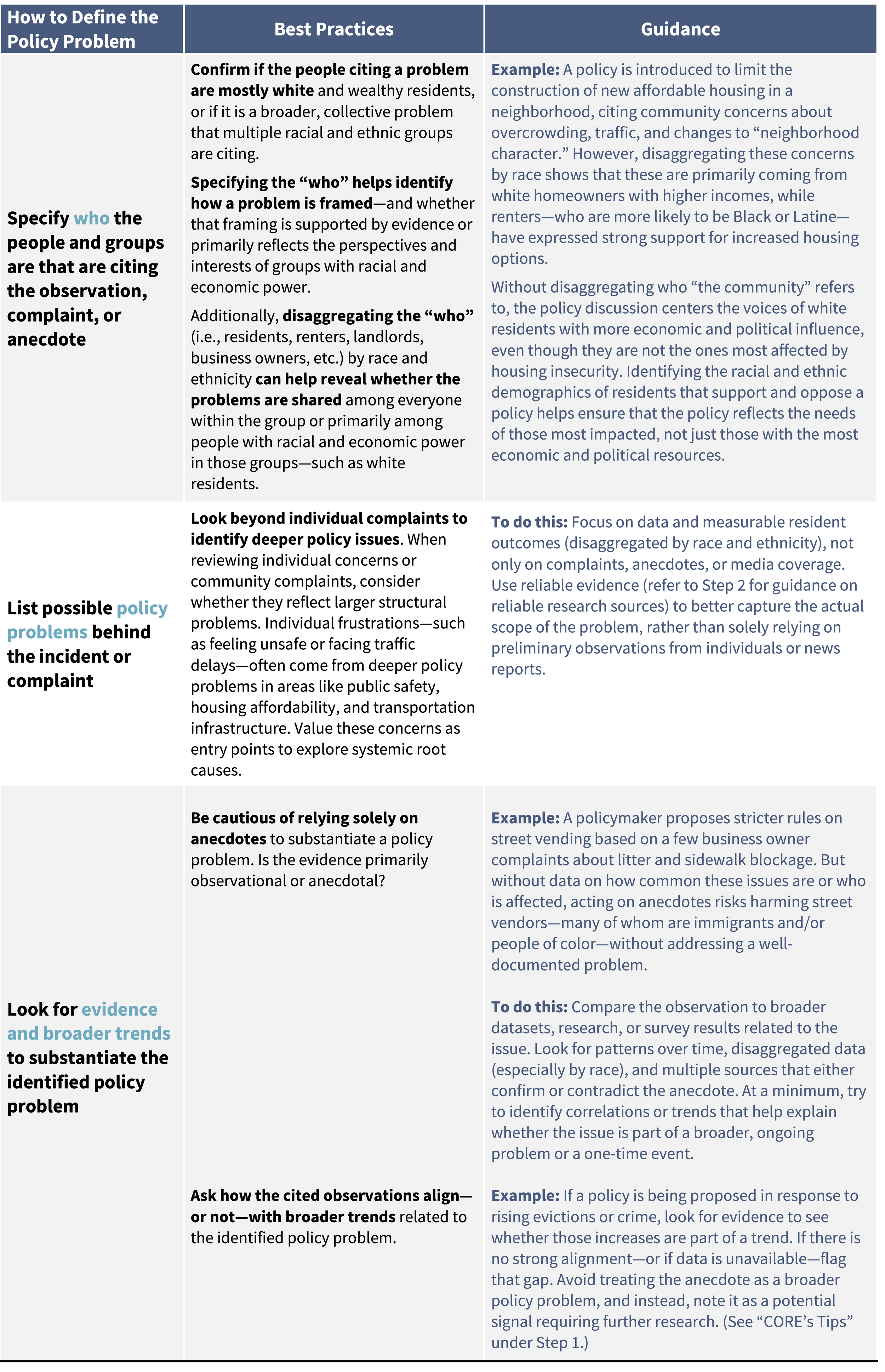
The figure below provides practical ways to define the policy problem, including key best practices that Council can incorporate.
CORE Tips
1. Find a baseline. Look for a point in time that helps show how the issue has affected general outcomes over time. Look for data, reporting, or research that shows a clear before-and-after. Also consider whether the issue is unique to the District by comparing it to trends in similar cities, states, or the US.
2. Correlations. Yes, a correlation is not a causation, but there should at least be a clear relationship between the observed issue and the cited problem. For example, if linking rising crime rates to recent changes in sentencing, there should be a noticeable correlation between them over time. Look for patterns across multiple months or years. And always consider and explain other possible factors that could account for the presence—or absence—of a correlation. Without this context, the policy rationale may be weak or misleading.
3. Timeline of events. If a current or past policy or incident is cited as the cause of a problem, build a timeline to see if the problem aligns with the changes. Map data points related to the problem alongside key policy actions and events to assess whether the timing supports the claim. For example, if a bill proposes rolling back police reform measures, in order to claim that changes made in 2015 led to a spike in violent crime, we would need to assess this. Build a timeline that maps when the reforms were enacted along monthly or quarterly crime data. If the increase in crime began before the policy changes—or does not consistently rise afterward—it weakens the claim that the reforms caused the spike, and therefore, we would avoid making this claim. A structured timeline helps clarify whether the timing of the issue actually supports initial thinking.
4. Let the evidence guide you. Be honest when there is not enough evidence to fully support the classification of “the problem.” Exaggerating or misrepresenting an issue to justify a policy can do more harm than good—it undermines the policy’s effectiveness and increases the risk of implementing solutions that harm residents of color. Instead, acknowledge when the evidence is limited or inconclusive. Use those limitations as an opportunity to recommend further research, deeper community engagement, or a pilot approach before advancing a full policy change. Designing racially equitable policy means letting the evidence speak—even when it introduces complexity or uncertainty.
Best Practices, Guidance, and Examples
Step 2: Determine the Policy’s Effectiveness
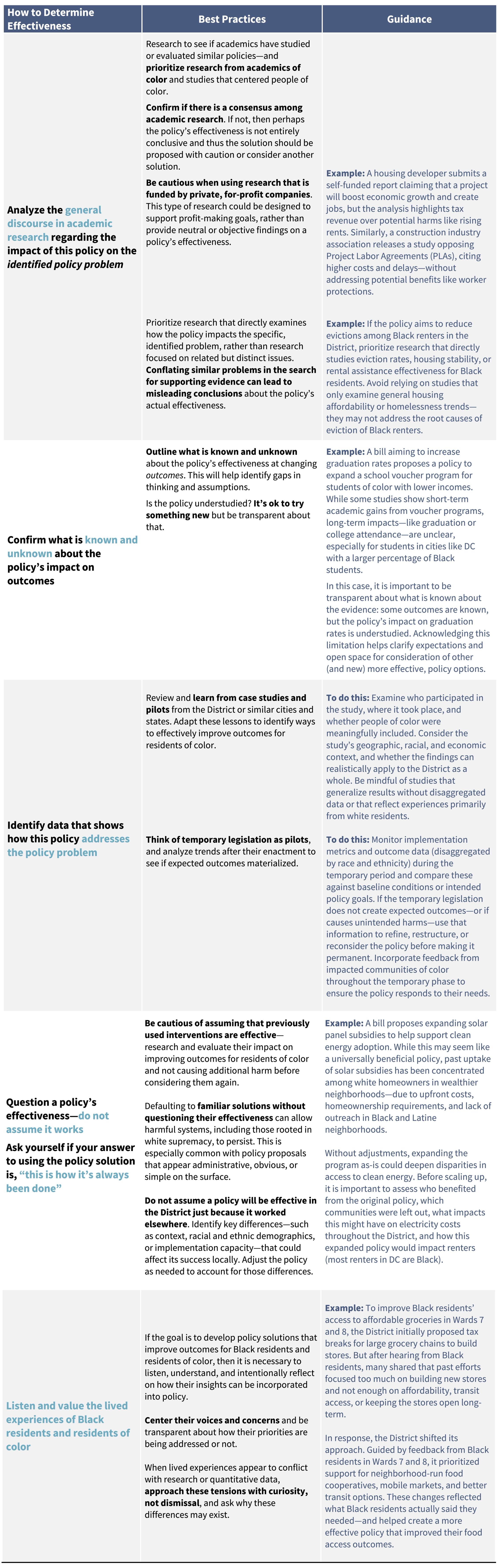
Once the policy problem is identified, defined, and supported by evidence, policymakers can begin proposing potential policy solutions. Just as it is important to use evidence to define the problem, it is equally critical to use evidence to support the effectiveness of any proposed policy solution.
While it may be tempting to rely on familiar or commonly used policy solutions, it is always essential to validate whether they actually work. Evidence evolves and so should policy solutions. Doing this due diligence ensures that interventions are not only well intentioned, but also effective.
Too often, policy solutions are not validated with evidence because they seem simple, straightforward, or administrative, but their simplicity does not mean their impact is guaranteed. At best, they may be ineffective, and at worst, they can perpetuate policies that unintentionally harm Black residents and residents of color.
CORE Tips
1. Prioritize primary sources. News articles and local reporting are helpful starting points but try to go to the original source to ensure the information is accurate. Government reporting and peer reviewed research can be more reliable at times.
2. Reference academic journals. Google scholar is a great, free option to start. If presenting research publicly (like through a committee report), try to use sources that are accessible to the public, rather than ones that are behind paywalls.
3. Select a policy intervention that is guided by evidence, not politics. Politics can often reinforce the status quo, respond to fear, and cater to people with power and resources—all of which can be shaped by and perpetuate white supremacy. Prioritizing evidence is one way to help break these patterns and can result in more effective solutions for residents of color.
4. Value qualitative evidence and lived experience. Lived experience is a valid and important form of evidence—especially when it comes from people of color whose experiences are often excluded from mainstream research and academic studies. These perspectives can provide critical insight into how a policy may impact communities and, at times, may offer the most relevant or revealing information available. Do not try to validate or invalidate lived experience using quantitative data; it stands on its own as meaningful evidence. When qualitative and quantitative data appear to conflict, acknowledge the tension rather than trying to resolve it. Both forms of evidence are valuable and deserve space in policy analysis.
Best Practices, Guidance, and Examples
Step 3: Specify Who Benefits from the Policy
It is not enough to ask whether a policy is effective in general—but also to ask who it is effective for.
Black residents and people of color experience life in the District differently than white residents due to deep and persistent racial disparities in income, wealth, housing, health, employment, and more. These differences—the result of generations of racially discriminatory policies and practices—mean that residents are often living very different lives in the same city. As a result, even well intended policies can fail to address the realities of residents of color if they are not designed with those realities in mind.
A policy that works in general likely will not work for everyone. Policy discussions often rely on generalized categories like “residents,” “renters,” “landlords,” “small business owners,” “parents,” or “youth.” But these categories obscure critical differences in outcomes and lived experience within them. Without identifying the race and ethnicity of the people in each of these groups, a policy risks missing critical differences in lived experience, opportunity, and access.
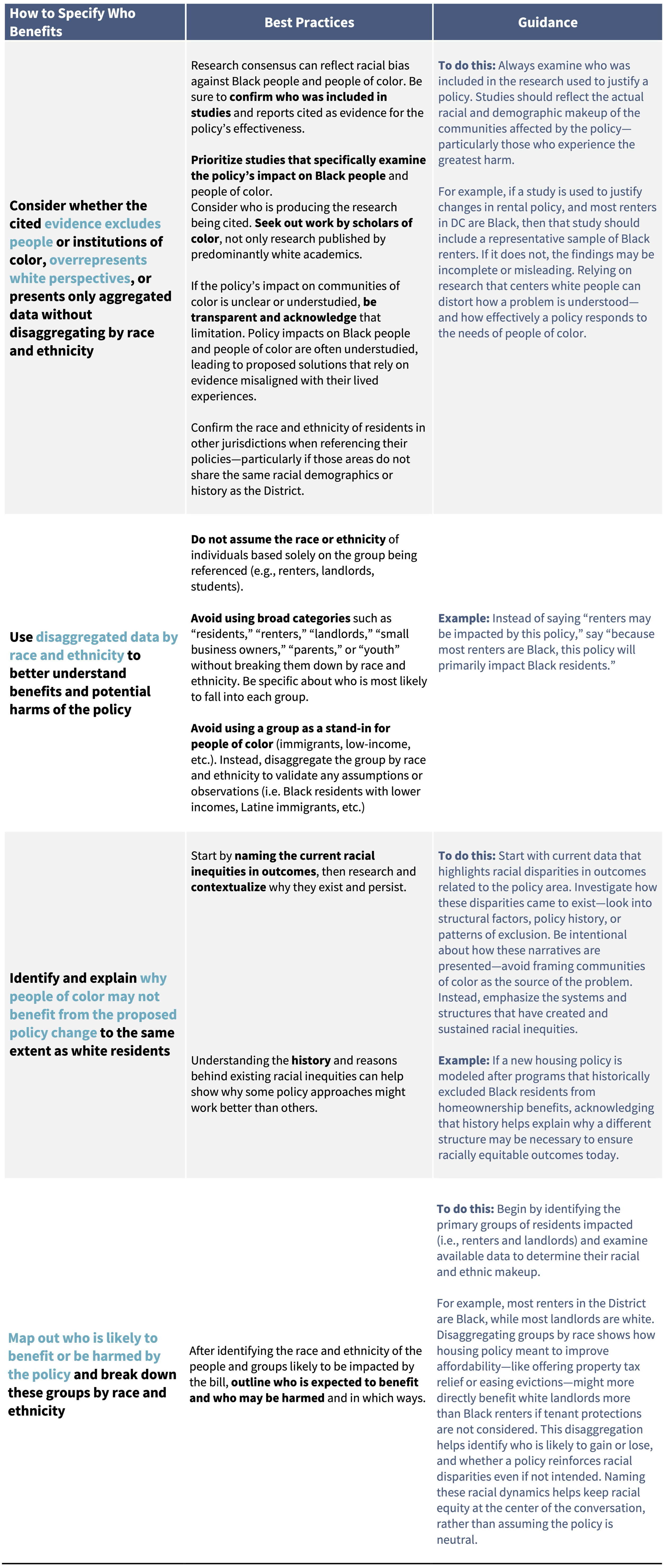
Designing policy without this level of specificity limits its impact. Without a clear understanding of the race and ethnicity of the people who could benefit, there is a risk of assuming that a policy will serve all groups equally, when in practice, it may not. Identifying who benefits from a policy is essential to ensuring that a policy is effective and equitable.
CORE Tips
1. Ask more targeted questions during public hearings, oversight hearings, and budget hearings. One of the Council’s most important powers is the ability to request information. Asking government agencies to provide disaggregated data by race and ethnicity—especially when evaluating programs and the potential impacts of a new bill—can significantly improve the analysis and understanding of how current and proposed policies impact residents of color.
2. Use targeted search terms to find more specific evidence that includes people of color. When searching for studies or data, combine the policy topic with key terms such as “race,” “racial equity,” “racism,” “Black people,” “Latino,” “Indigenous people,” or “people of color” to surface more relevant and inclusive research. This may seem obvious, but much of this research remains overlooked unless specifically sought out using these terms.
3. Be specific about groups. Even if it seems evident who is more likely to have lower incomes, be renters, or face limited access to health care, it is essential to name those groups explicitly. If the affected residents are mostly Black, say they are mostly Black. If they are mostly white, say they are mostly white. Naming race and ethnicity clearly exposes the role of structural racism and makes both the benefits and harms of a policy more tangible and accountable.
Best Practices, Guidance, and Examples
Step 4: Contextualize the Policy’s History and Impact on People of Color
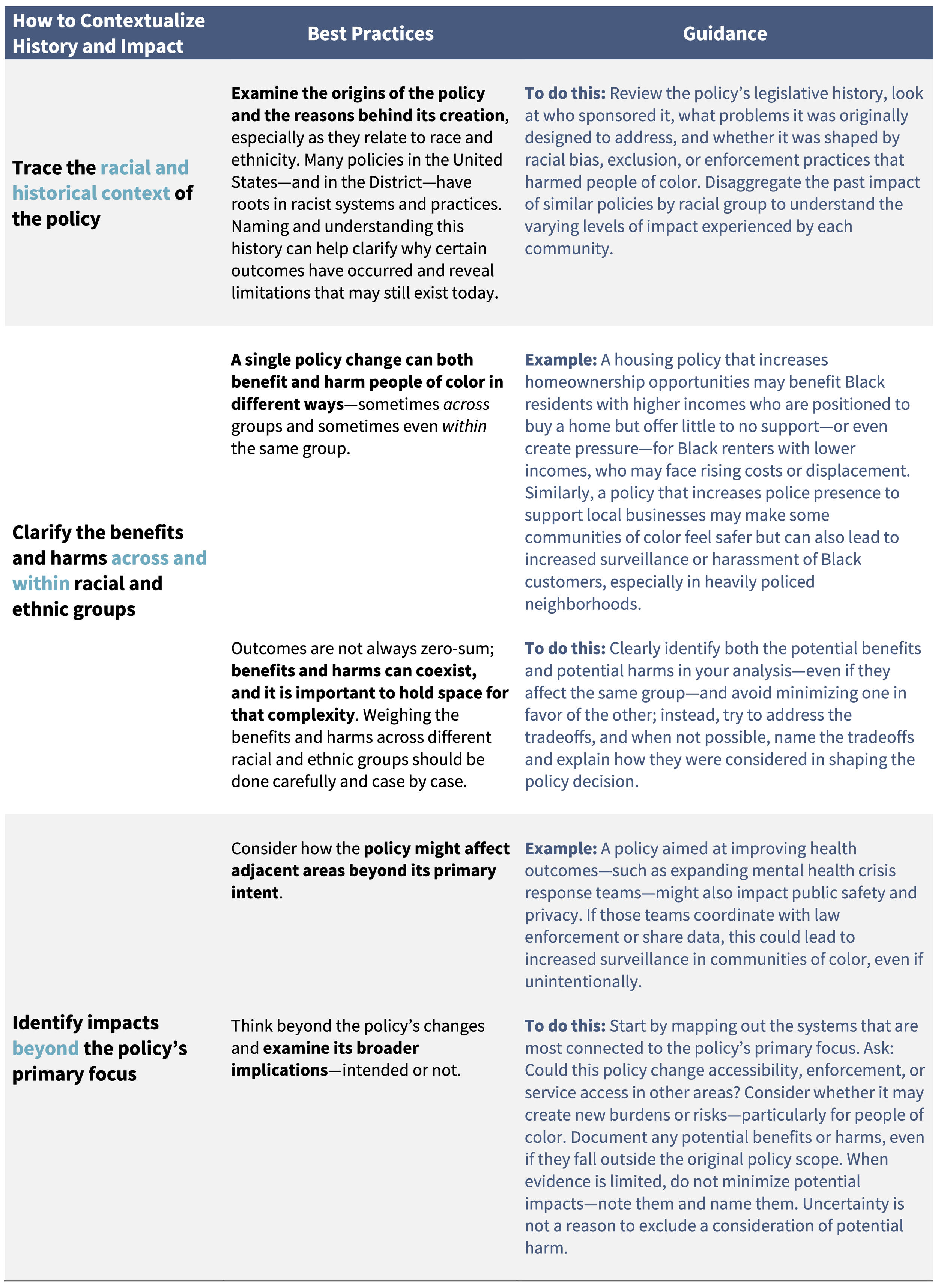
Contextualizing a policy’s history and impact on people of color is important to ensuring racially equitable outcomes. Beyond a policy’s stated intent and effectiveness, understanding the historical context of a policy—and similar policies—can help prevent the repetition of past harms. Much of the existing policy landscape was shaped by racism, particularly anti-Blackness. Even if current intentions differ, continuing to use policies without acknowledging their origins or context can perpetuate the same racial inequities.
It is also important to recognize that a policy may impact people of color in ways that extend beyond the policy’s primary focus. Policies do not operate in isolation—they often influence multiple aspects of people’s lives, such as health, wealth, housing, and safety. Acknowledging and analyzing these broader intersections is a thoughtful and necessary part of responsible, effective policymaking.
CORE Tips
1. Use Specific Language and Active Voice. We promote racial equity by being specific and using active voice. That means clearly naming who is responsible for each action—especially in the context of policy. This makes both the sources of harm and the parties of benefit more visible and concrete. This also strengthens research by surfacing actions that may otherwise remain hidden or ambiguous. White supremacy and racial inequity often persist through ambiguity and passive language, which obscure accountability and avoid confronting the harmful legacies embedded in present-day policies. Using active voice helps name actors, clarify responsibility, and ultimately strengthen a policy’s ability to improve outcomes for people of color.
2. Trace the Historical Trauma: When proposing to change, continue, or introduce a policy, trace its history as it relates to racism. Ask: What were the original intentions of this policy? Was it designed to harm Black residents or block access to certain outcomes? Or perhaps, if it was not designed with this intent, analyze if the impact of this policy has harmed Black residents or blocked access to certain equal outcomes? Remember, even if a policy looks race-neutral today, it may still continue practices that create racial harm. History also shows how residents of color may or may not trust the policy, which can affect its effectiveness. Take time to uncover racist origins and outcomes, not only to design more effective policies but also to repair harm and help move the District toward racial equity.
3. Impact across groups of people of color: When analyzing racial equity, consider differences across communities of color—not just differences between residents of color and white residents. Residents of color often experience systemic racism and policies in distinct ways. For instance, changes to the criminal code may affect Black residents more deeply because of the long history of over-criminalization, while immigration policies may more directly impact Latine residents. These impacts are not exclusive to one community, but they can fall more heavily on some than others.
As you consider equity, avoid thinking of “residents of color” as a single group. Instead, take time to understand how each community experiences policy. Name their experiences. This means grounding your analysis in both data and history. While many communities of color share similar disparities compared to white residents—shaped by racism and inequities in wealth, health, education, and opportunity—this is not always the case. Recognizing both the shared and unique impacts, policies can more effectively respond to the needs of each community and impact outcomes.
4. Individual vs Collective Impact: Individual experiences matter but always consider the impact on the group as a whole. For example, a few Black homeowners may be disadvantaged by a housing policy change, but that should not outweigh the broader benefits for Black residents overall—especially when most are renters and when viewed in the historical context of policies that have harmed Black communities collectively. Be careful not to tokenize individual experiences in ways that reinforce long standing patterns of harm against communities of color.
This is especially important in justice and public safety policy. While Black residents could benefit greatly from more effective public safety, the key word is effective. Black residents are more likely to be victims of crime, yet their experiences are too often referenced to justify ineffective “tough-on-crime” policies that rely on punitive and overpolicing approaches rather than strategies that actually prevent and reduce harm.
The goal should be to reduce crime through policies that are effective and do not cause further harm to Black residents as a collective. True public safety should not come at the expense of the very communities it claims to protect.
Best Practices, Guidance, and Examples
Header mural painted by Eric B. Ricks as part of DPW's MuralsDC program.